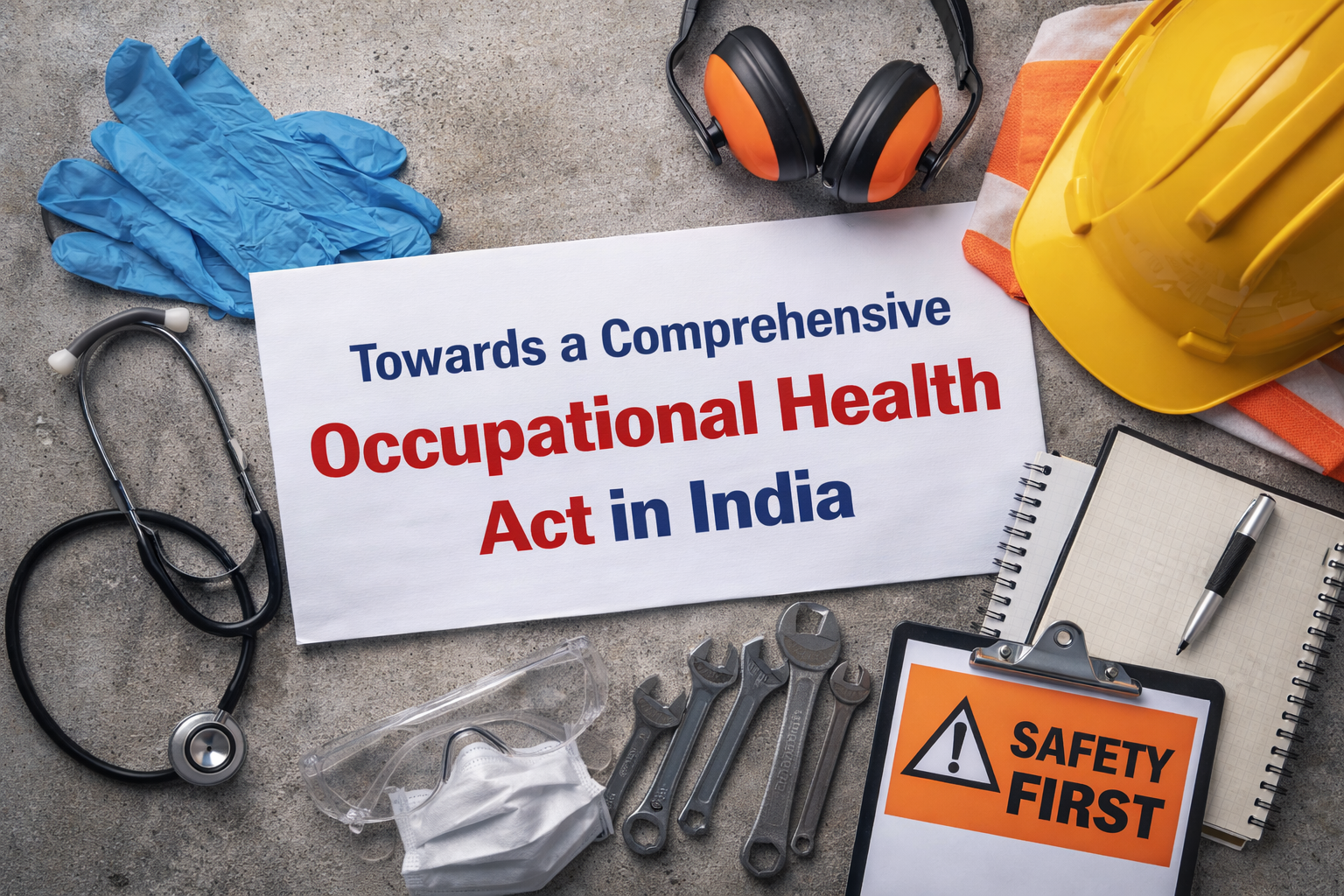
Towards a Comprehensive Occupational Health Act in India
Published on February 2, 2026
India in 2026 is increasingly industrialized with substantial amount of employment being generated in the unorganized and organized sector. With introduction of artificial intelligence, data analytics and system dependence, the nature of occupation is also undergoing vast transformation. This naturally presents risks and rewards, which suggests greater emphasis on human safety, need for trained occupational health physicians and also the need for resource allocation in health infra at spaces of shared needs.
The need for a comprehensive occupational health act in India
Workplace transformation needs mainstreaming not just in the organized sector, but also the unorganized sector which is much higher in number. The nature of work has over decades gone through major changes, also requiring a better system to protect workers, to protect all kinds of employees and also to ensure fairness for the employer. The Occupational health act must balance the employer – employee relationship so neither side feels pressurized. Creating safety nets beyond the Factories Act, Mines Act becomes the order of the day. New service sectors have cropped up like Business Process Outsourcing (BPOs), IT Sector, Food and other delivery units leading to availability of cheap labour, lack of health safeguards, apathy of stakeholders, multiplicity of statutory controls and infrastructure challenges.
With limited number of trained occupational health physicians available around the country and rising concerns around mental health, work related stressors, creating more number of occupational health physicians capable of handling technology driven systems for equitable access and social justice becomes imminent. This also paves way for the need to factor in all types of work and also integrating the line department of the Ministry of Labour and Ministry of Health and Family Welfare since the Ministry of Public Health does not yet exist in India. Through the creation of the occupational health act, spending on occupational health must improve as well. There is a wide gap of undiagnosed and unreported occupational health related disease burden which continues to snowball into larger health issues. Budgetary constraints for employers, proliferating socio-economic conditions further add in concert, new challenges that can be met to build the employer-employee relationship.
The Factories Act 1948, The Mines Act 1952, The Contract Labour Act 1970, The Building and other Construction workers Act 1996 must be abolished and merged into an Occupational Health Act 2025 comprehensively protecting workers, besides also providing support to employers. Further, The Employees State Insurance Act, 1948 must be replaced with Employer Employee Social Protection Act 2025.
Focusing on preventive health
Alienation of occupational health and work-related consequences over the years have led to gross neglect of people embracing preventive health. Until health conditions get complicated, citizens and work force as well, continue to neglect their health, engage on uncontrolled dietary patterns and prefer fast food, consume oil and fried items and disrupt the body metabolism to critical levels, also not finding time for physical activities. Through the occupational health act, the emphasis on preventive health and family medicine must gather storm so that as a nation, a health workforce can be created.
Government of India must support all employers, organizations, non-profits with a scheme for yearly annual health check ups and the cost must be met by the Government. This will lead to social protection besides also building the consciousness for preventive health in India. Institutes of Public Health must be tasked to work with line Ministries to strengthen implementation gaps, create capacity building initiatives, undertake research and policy programmes and provide supportive hand-holding to industries. Consultants in preventive health and family medicine can be tapped to increase the access and coverage of occupational health issues in the country, and they can support employers and employees in making risk informed policy and planning. Institutes of public health can further indulge in creating protocols of workplace risk assessment, monitoring of workplace hazards, effective health surveillance and creation of safety nets.
Revising the medical curriculum in Preventive Medicine & Family Health
Restructuring the medical curriculum for preventive and family medicine both at the MBBS level and the MD level will serve to orient a new cadre of workforce. Post MD Preventive Medicine, a six month fellowship in occupational medicine will also support to address the shortage that exist and it would provide for the creation of a pool of talents available for providing service in the occupational medicine space. As it stands today, the preventive medicine curriculum lacks depth and emphasis, besides also lacking exposure to address the occupational health needs. For a vast and diverse population base like India, nurturing MD preventive health physicians into occupational medicine will leap frog policy gaps in the labour space and also support creation of a healthy nation.